Where to Host a Lovable or Bolt App: Netlify vs Vercel vs Hostinger (2026)
StackReview is reader-supported. When you buy through links on our site, we may earn an affiliate commission. This never influences our scores.
Quick verdict
This comparison covers Netlify vs Vercel vs Hostinger for no-code and vibe-coding builders moving a Lovable or Bolt project onto their own hosting and domain. Check your stack first. Vercel Pro or Netlify suit most Lovable and Bolt apps. Hostinger is cheapest for a multi-year business site if you accept its renewal pricing.
Key facts
| Price | Vercel Hobby free (non-commercial), Pro $20/month. Netlify Free (300 credits), Personal $9, Pro $20. Hostinger Unlimited $3.49/mo on a 48-month term (renews $16.99/mo, USD). Checked 20 October 2026. |
|---|---|
| Best for | No-code and vibe-coding builders moving a Lovable or Bolt project onto their own hosting and domain |
| Free plan | Yes — limits apply; see pricing details |
| Rating | Not rated (comparison or guide) |
Summary
Check your stack first. Vercel Pro or Netlify suit most Lovable and Bolt apps. Hostinger is cheapest for a multi-year business site if you accept its renewal pricing.
Best for: No-code and vibe-coding builders moving a Lovable or Bolt project onto their own hosting and domain

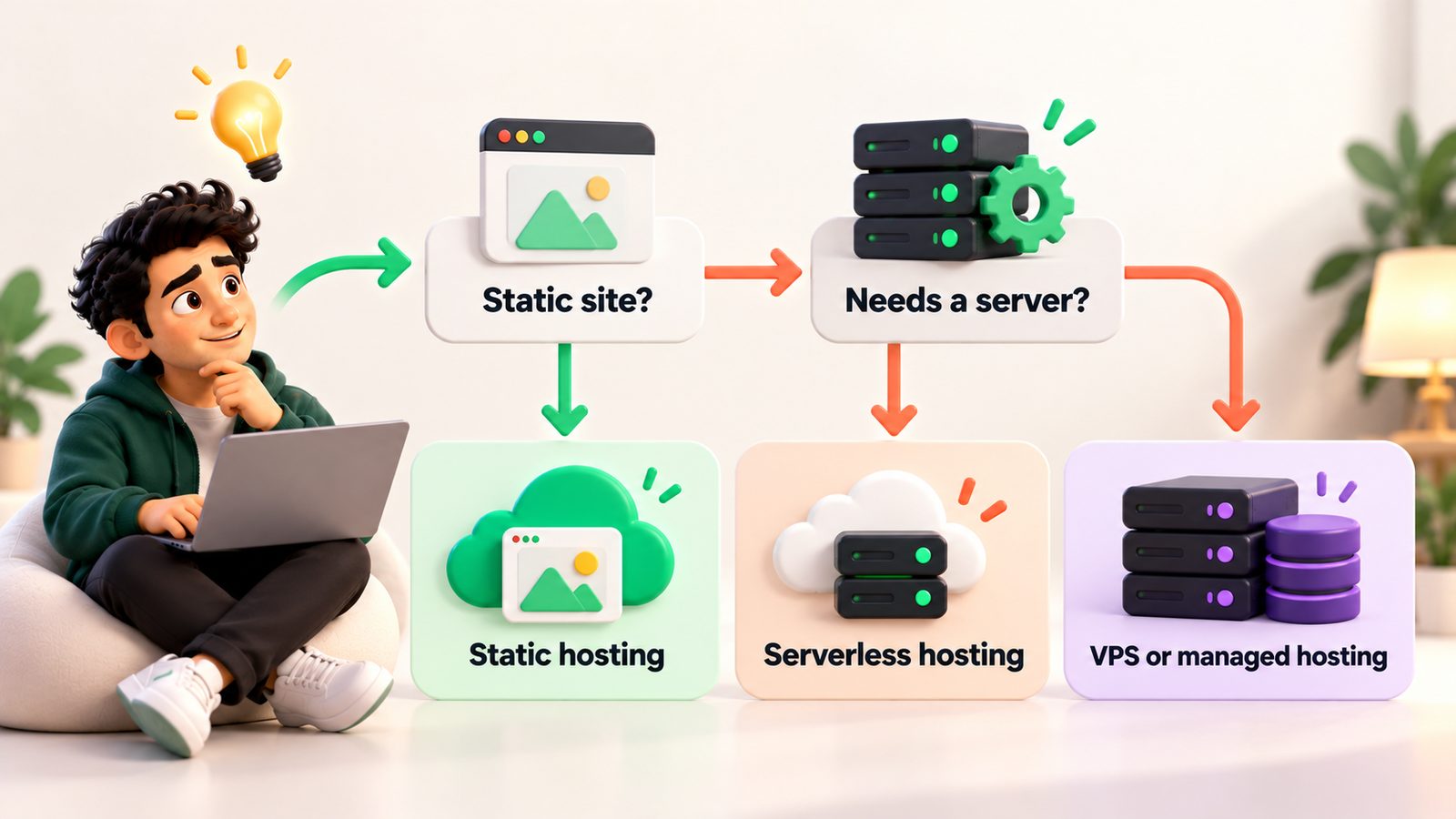
TL;DR: First check which stack your project uses. New Lovable apps (created from 13 May 2026) use TanStack Start, which needs a host that can run a server. Vercel and Netlify detect it automatically. On Hostinger it has to run as a Node.js web app. For most people, Vercel Pro ($20/month) or Netlify (free to $9/month) is the simplest choice. Hostinger is the cheapest multi-year option for a business site, provided you plan for its renewal price.
Lovable and Bolt will both host your app for you. Lovable publishes to a lovable.app address, and Bolt publishes to bolt.host by default. Custom domains and badge removal need a paid plan on each. Many builders then ask whether to keep paying the builder or move the code somewhere cheaper. This comparison uses official pricing and docs checked on 20 October 2026.
Quick comparison
| Vercel | Netlify | Hostinger | |
|---|---|---|---|
| Free tier | Hobby, $0, personal non-commercial use only | Free, $0, 300 credits a month (hard limit) | None (paid plans only) |
| Cheapest paid | Pro, $20/month (1 deploying seat, $20 usage credit) | Personal, $9/month (1,000 credits) | Unlimited, $3.49/mo on a 48-month term, renews at $16.99/mo |
| Runs TanStack Start (server) apps | Yes, auto-detected | Yes, auto-detected | Yes, as a Node.js web app |
| Static React + Vite apps | Yes | Yes | Yes |
| Custom domain | Yes | Yes, on all plans | Yes (domain free for year 1) |
| Deploy from GitHub | Yes | Yes | Yes (Import Git Repository) |
| Best for | Production apps and client work | Hobby projects and small commercial sites | Long-term business sites, email included |
Sources: vercel.com/pricing, Vercel fair use guidelines, Vercel Pro docs, netlify.com/pricing, Netlify credit docs, Hostinger Lovable hosting. Hostinger prices are from hostinger.com in USD.
Step one: which stack is your app using?
Lovable's FAQ says new apps created from 13 May 2026 (22 June 2026 for Enterprise workspaces) "use TanStack Start, which renders pages on the server." Older apps use React + Vite and render in the browser.
This affects where you can host:
- TanStack Start apps need a host that runs server code. Lovable's external hosting guide says such an app "does not run from object storage or a CDN alone." Vercel, Netlify and Cloudflare Pages are detected automatically. Anywhere else, you build with Nitro's Node.js preset and run it on Node.
- React + Vite apps build to a static dist folder with npm run build and can sit on any static host. You need a fallback rule that serves index.html so client-side routes don't return 404 errors.
To check, open package.json in Lovable's Code tab. A TanStack Start project lists @tanstack/react-start as a dependency. You can also ask Lovable in chat which stack the project uses.
Bolt projects publish to Bolt hosting by default. Bolt's Netlify integration doc warns that Netlify "can't host a database or a traditional backend," so projects that store user data should stay on Bolt hosting or move their backend separately.
How to get your code out
- Lovable: GitHub sync works on every plan, including Free, and repositories are private by default (Lovable GitHub docs). Connect GitHub, then import the repo into your new host.
- Bolt: switch the provider to Netlify in Domains & Hosting (you must unpublish from Bolt first), or export the project and deploy it like any other repo.
Environment variables. If you keep Lovable Cloud as the backend and host the front end elsewhere, copy the values from your project's .env file. Browser builds need VITE_SUPABASE_URL and VITE_SUPABASE_PUBLISHABLE_KEY. TanStack Start apps also need the server-side SUPABASE_URL and SUPABASE_PUBLISHABLE_KEY. Lovable says the Cloud backend keeps working when the front end is hosted elsewhere, but managed OAuth configuration and automatic token refresh only work through Lovable's own hosting. If you use your own Supabase project, add the new domain to its auth settings.
Vercel: the default for real apps, if you pay
Vercel's Hobby plan is generous on paper: 100 GB of fast data transfer, 1 million function invocations and 1 million CDN requests a month. But Vercel's fair use guidelines restrict Hobby to "non-commercial personal use only." The definition is broad. It includes taking payments, advertising a product or service, ads, an affiliate-led site, and being paid to build the site. Most business landing pages are therefore commercial.
Pro is a $20 monthly platform fee that includes one deploying seat and $20 of usage credit. Extra deploying seats are $20 each, and viewer seats are free. For a solo founder that's $240 a year, and you rarely think about it again.
Pick Vercel if your app has real users or revenue and you want the least configuration.
Netlify: the best free tier for small projects
Netlify moved to credit-based plans. The Free plan includes 300 credits a month with no top-ups. When the credits run out, your projects pause until the next cycle. According to Netlify's credit docs, credits are used like this:
- Production deploy: 15 credits
- Bandwidth: 20 credits per GB
- Compute (functions, server rendering): 10 credits per GB-hour
- Web requests: 2 credits per 10,000
- Form submissions: free
Worked example. You push changes from Lovable about four times a week, so roughly 17 production deploys a month. That's 17 × 15 = 255 credits, leaving 45 credits, or about 2.25 GB of bandwidth (45 ÷ 20), before compute and requests. On the free plan, frequent deploying uses up credits faster than traffic does. Personal ($9/month, 1,000 credits) removes that worry for most small sites. Pro ($20/month) starts at 3,000 credits and allows unlimited members.
Netlify's pricing page includes custom domains with SSL on every plan, including Free.
Pick Netlify if you want a usable free tier, or a cheap paid plan for a small commercial site.
Hostinger: cheapest over four years, with renewal costs to plan for
Hostinger has a dedicated Lovable hosting page and a support guide for Lovable and Bolt sites. You can import from GitHub (with auto-detected build settings) or upload a ZIP, and Hostinger runs the app as a managed Node.js web app. That means TanStack Start apps work without managing a server.
On hostinger.com (USD, checked 20 October 2026, during Hostinger's Black Friday promotion):
- Unlimited: $3.49/mo for 48 months ($167.52 upfront), renews at $16.99/mo
- Cloud Startup: $7.99/mo for 48 months ($383.52 upfront), renews at $25.99/mo, 10 web apps, 4 CPU cores, 4 GB RAM
Hostinger's older support article lists Node.js apps on Business and Cloud plans (5 and 10 apps), while the current pricing cards show Node.js on every tier, including Premium. Plan names appear to have changed, so confirm Node.js support for your chosen plan at checkout. Prices vary by region and currency.
The main advantage is that the plan also covers business email, a domain for the first year, and as many ordinary websites as your plan allows. The drawback is the renewal: after the first term, Unlimited costs $16.99 a month. We break that down in Hostinger renewal price 2026.
Pick Hostinger if you want one bill for the app, a marketing site and email, and you're comfortable paying for four years upfront.
Should you just stay on Lovable or Bolt?
Often, yes. Moving saves money only if your builder plan is just for hosting.
- Lovable: custom domains and removing the "Edit with Lovable" badge need Pro (from $25/month) or higher (Lovable plans). If you keep building in Lovable anyway, you already pay for hosting.
- Bolt: free hosting includes up to 10 GB of bandwidth and 333,333 requests a month with a "Made in Bolt" badge. Pro raises that to 30 GB and 1 million requests, adds custom domains and removes the badge (Bolt hosting plans). Bolt lists Pro at $18/month billed annually ($216 a year) on bolt.new/pricing.
One-year cost for a small business app
A commercial landing page with a contact form and modest traffic:
| Option | Year-one cost | Notes |
|---|---|---|
| Netlify Free | $0 | Only if you stay under 300 credits; the site pauses if you don't |
| Netlify Personal | $9 × 12 = $108 | 1,000 credits a month |
| Vercel Pro | $20 × 12 = $240 | Hobby isn't allowed for commercial use |
| Hostinger Unlimited | $167.52 upfront for 4 years (≈ $41.88/year) | Then $16.99 × 12 = $203.88/year from year 5 |
| Bolt Pro (stay put) | $216 | Includes AI building tokens too |
Which should you choose?
- Personal project or portfolio, no money involved: Vercel Hobby or Netlify Free.
- Small commercial site, rare deploys: Netlify Free, or Personal at $9.
- Real product with users or payments: Vercel Pro.
- Business site plus email, long horizon: Hostinger. Read the Hostinger review first.
- Still building every week: stay on Lovable or Bolt's paid plan and use their hosting.
For more on matching a host to how you build, see our hosting guide for no-code makers, freelancers and small teams.
FAQ
How do I host my Lovable project on my own domain?
The simplest route is a paid Lovable plan (Pro or higher), which adds custom domains. To host elsewhere, connect GitHub (available on the Free plan), import the repository into Vercel, Netlify or Hostinger, add your environment variables, and point your domain to the new host. Your lovable.app address keeps serving the last version published from Lovable.
Can I host a Lovable app on Vercel's free plan?
Technically yes, but only for personal, non-commercial use. Vercel defines commercial use broadly, including taking payments, advertising a service and showing ads. Business sites need Pro, which costs $20 a month.
Does Netlify work with Bolt?
Yes. Bolt has a native Netlify integration in Domains & Hosting. Bolt's docs say Netlify can't host a database or traditional backend, so apps that store user data should stay on Bolt hosting. Editing the auto-generated Netlify URL from Bolt is limited to Bolt Teams plans.
Can Hostinger shared hosting run a Lovable app?
Yes, through Hostinger's managed Node.js web apps, which accept GitHub imports or ZIP uploads. New Lovable apps (TanStack Start) need that server runtime. Older React + Vite apps are static and only need the built files plus an index.html fallback rule.
What is the cheapest way to host a Bolt or Lovable app?
For non-commercial projects, Vercel Hobby or Netlify Free costs nothing. For a commercial site that rarely changes, Netlify Free or Personal ($9/month) is usually cheapest. Over four years, Hostinger's 48-month plans have the lowest average cost, but the renewal price applies after that.
Pricing
Vercel Hobby free (non-commercial), Pro $20/month. Netlify Free (300 credits), Personal $9, Pro $20. Hostinger Unlimited $3.49/mo on a 48-month term (renews $16.99/mo, USD). Checked 20 October 2026.
Verdict
Check your stack first. Vercel Pro or Netlify suit most Lovable and Bolt apps. Hostinger is cheapest for a multi-year business site if you accept its renewal pricing.
Visit Netlify vs Vercel vs HostingerAlternatives to consider
Get the next review first
One honest SaaS review in your inbox each week. No spam, unsubscribe anytime.
About the author
Sunny Dubey
Founder & Editor of StackReview. Sunny runs a digital marketing company in India and has spent years buying, deploying, and abandoning SaaS tools for his own team — every review here is tested, written, and scored by him after weeks of real use.
More from Sunny Dubey →